The Real Reason Enterprise AI Fails to Scale: It’s Not the Model
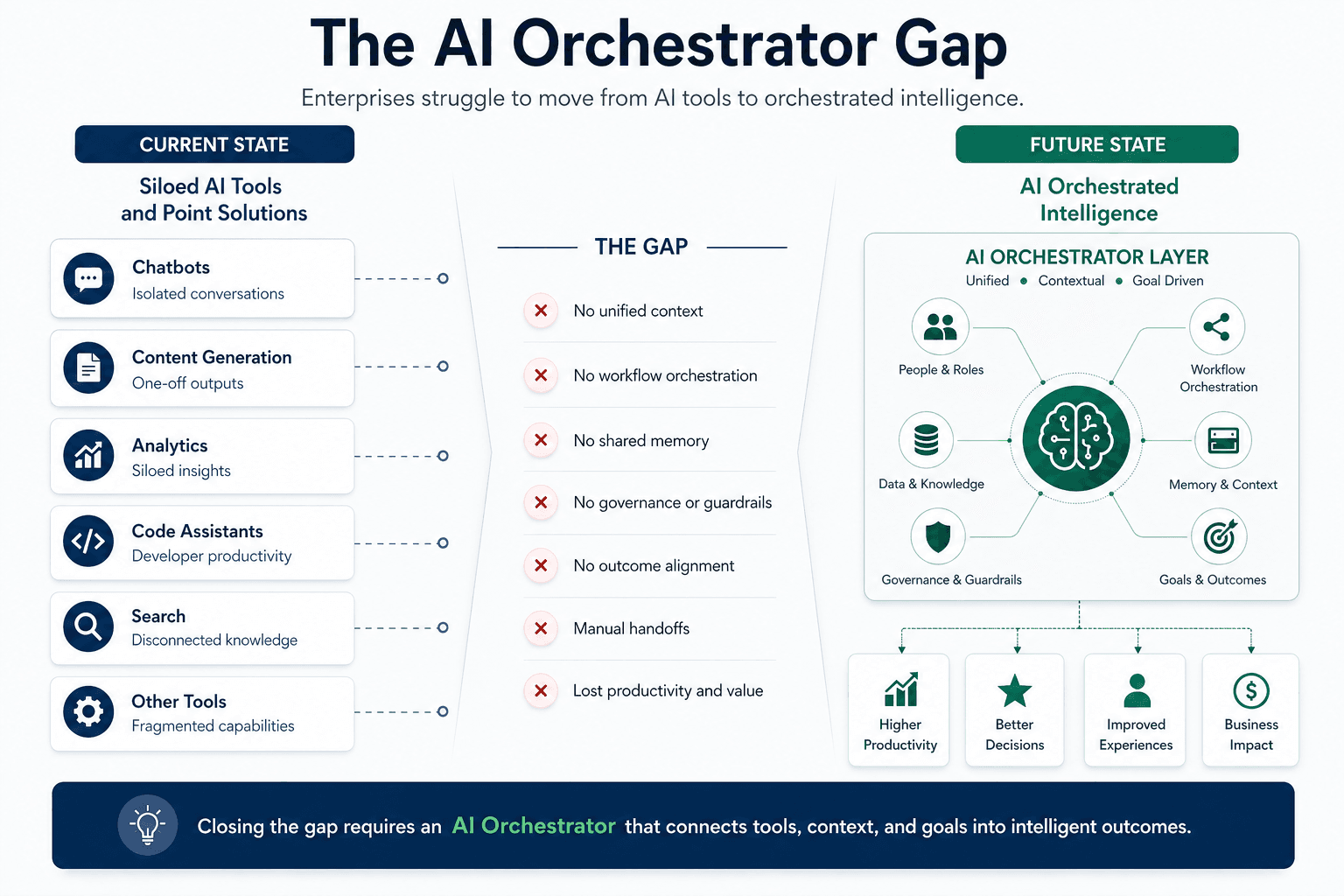
The gap no one talks about
Most enterprises are no longer asking whether AI works. They’ve already seen it: pilot projects deliver results, teams build useful internal tools, and early wins prove the potential. But those wins rarely extend beyond isolated teams. What works in one department often fails to translate across the organization. Not because the models are weak—but because the system around them is incomplete.
The illusion of progress
On the surface, AI adoption looks successful. There are dashboards, automations, insights, and reports. But when you step back, a pattern emerges:
- Insights don’t translate into action
- Workflows remain disconnected
AI generates outputs—but those outputs don’t consistently drive decisions or execution. So while activity increases, impact doesn’t scale.
The missing layer: execution coordination
The real problem isn’t intelligence. It’s coordination. AI can generate answers, predictions, and recommendations. But turning those into real, cross-functional action requires something more. It requires a system that can connect decisions across teams, move work across tools and processes, and maintain continuity across workflows.
Without this layer, teams are forced to manually carry AI outputs forward. And as usage grows, so does complexity. You get more tools, more dependencies, and more operational overhead. Instead of simplifying work, AI starts adding friction.
Why traditional AI platforms fall short
Most AI platforms were built to generate outputs—not to manage execution. They answer questions, but they don’t move work. So organizations compensate by stitching together workflows manually. At small scale, this works. At enterprise scale, it absolutely breaks.
Rethinking AI: from tools to systems
To make AI truly effective, the evaluation criteria must change. It’s no longer about model benchmarks, feature lists, or demo performance. The real question is:
Can this system reliably turn intelligence into action across the business?
Enter agent-driven systems
This is where agent-based architectures change the equation. Instead of just generating responses, agents can take a defined goal, break it into executable steps, coordinate actions across systems, and track progress over time.
What used to require constant human coordination becomes structured, automated execution. AI shifts from being a tool to becoming an operational layer.
The role of humans doesn’t disappear—it evolves
The goal of AI is not to replace people. It’s to remove the coordination burden that slows them down. Humans still set direction, define goals, and make strategic decisions. AI handles the repetitive coordination, system-to-system execution, dependency tracking, and workflow continuity.
This creates a better balance. People focus on thinking. AI handles the movement of work.
The KindDots perspective
At KindDots, we don’t see AI as a collection of tools. We see it as a system that must connect data, decisions, and execution. Because without connection, intelligence doesn’t scale.
That’s why our approach is simple: “Connect Right. Output Smart.”
When inputs are structured, systems are aligned, and workflows are clear—AI stops being experimental and starts becoming dependable.
Final thought
AI isn’t failing in enterprises because it lacks capability. It’s failing because it lacks structure. Until intelligence is connected to execution, progress will remain fragmented.
The shift ahead is clear: we are moving from isolated AI outputs to coordinated, system-driven execution. That’s where real impact begins.